SIX DAYS AT SEA.
On A Good "Average' Cruise to Havana. The Four Handsome Airedales
Wanted Girls; the Girls Wanted Husbands; the Tourists Wanted
a Hot Time Ashore; The Cuban Boys Wanted Transportation. The
Cubans Got What They Wanted.
Force of habit awakened elderly Mr. And Mrs. B. early and they
were strolling t he long decks hand in hand a half-hour before
the dining saloon opened at eight. Two heavy women in new house
dresses helped each other up the stairs, their lungs laboring.
They were Mrs. C. and her feeble sister. They and the B's nodded
and smiled and said what a lovely morning it was and moved on in
opposite directions. Mr. B. replaced his alpaca cap and told his
gentle, pretty, wife how fine the sea air was and what an appetite
it gave a fellow. The sun stood bright on the clean, already warm
decks, the blue water enlarged quietly without whitening and sang
along the flanks of the ship like seltzer.
Miss Cox appeared with her aunt Miss Box a frugal and sweet smiling
spinster. Miss Box wore a simple print and a shining black straw
garlanded with cloth flowers; Miss Cox was in severely informal
new sports attire. Like most of the other young women, low salaried
office workers upon whom the self sufficiency, the independence
of city work and city living had narrowed their inestimable pressures
of loneliness and of spiritual fear, she set a greater value of
anticipation upon this cruise than she could dare tell herself.
For this short leisure among new faces she had invested heavily
in costume, in fear, in hope; and like her colleagues she searched
among the men as for steamer smoke from an uncharted atoll.
Small and very lonesome in a great space of glassed in deck, an
aging Jew in a light flannel suit gazed sorrowfully at the Atlantic
Ocean. A blond young man who resembled an Airedale sufficiently
intelligent to count to ten, dance fox trots and graduate from
a gentleman's university came briskly into the dining room in sharp
pressed slacks and a navy blue sports shirt, read the sigh, dashed
away and soon reappeared plus a checkered coat and a plaid tie.
The dining saloon opened. Among big white tables glistening with
institutional silverware all the white-coated stewards stood in
sunlight with nothing yet to do. They were polite but by no means
obsequious; like the room stewards and the rank and file of the
crew they had a good stiff draught of the C.I.O. The headwaiter,
a prim Arthur Treacher type conveyed his guests to their tables
with the gestures of an Eton-trained sand hill crane in flight.
His snobbishness rather flattered a number of the passengers.
Mr. And Mrs. B. studied them pretentious menu with admiration
and ordered a whale of a breakfast. They may charge you aplenty,
but they certainly do give you your money's worth. Mr. L. a bearish
Jew, and his wife, the hard glassy sort of blonde who should even
sleep in jodhpurs tinkered at their fruit and exchanged monosyllables
as if they were forced bargains. The Airedale pricked up his ears
as two girls came in and as quickly drooped them worried his Rice
Krispies, hoping that to the two girls already seated he had appeared
to establish no relationship with the newcomers who were not at
all his meat. Mr. and Mrs. L. in the manner of the average happily
married couple, brightened immediately and genuinely as friends
entered. The cool china noise and the chattering thickened in the
cheerful room while, with the casualness of concealed excitement,
studiously dressed and sharply anticipatory, singly and by twos
and threes the shining breakfast faces assembled, looking each
other over. The appraisals of clothes, of class, of race of temperament,
and of opposite sexes met and crossed and flickered in a texture
of glances as swift and keen as the leaping closures of electric
arcs, and as essential irrelevant to mercy. These people had come
aboard in New York late the evening before, and this was their
first real glimpse of each other.
All told, there were about one hundred thirty two of them aboard.
Perhaps twenty of them, mostly Cubans, were using the ship for
the normal purpose of getting where they were going, namely, Havana.
The others were creatures of a different order. They were representatives
of the lower to middle brackets of American urban middle class
and they were on a cruise. Forty of them would stop a week in Havana;
they were on a thirteen- day cruise. Sixty- eight of them would
spend only eighteen hours in that city. They were on the six- day
cruise. Most of them were from the cities of the Eastern seaboard;
many were from the New York City area. Roughly one in three of
them was married, one in three was Jewish, one in three was middle
aged. Most of the middle aged and married were aboard for a rest:
most of the others were aboard for one degree or another of a hell
of a big time. The unattached women and girls, who were aboard
partly for a goodtime and partly for the more serious, not to say
desperate, purpose of finding a husband, outnumbered the unattached
men about four to one going down, and about six to one coming back.
There were few children. It wasn't a very expensive outing they
were taking: most of them spent between $85 and $110 for passage
but $70 was enough to cover every expense except tips for six days.
There were bar expenses; and plenty of the passengers, particularly
the younger ones, had invested pretty heavily in new clothes they
could fee self-assured in; for most of them had never been on a
cruise before and had rather glamorous ideas of what it would be
like. Few of them could swing this expense lightly, and plenty
of them knew they should never have afforded it at all. But they
were of that vast race whose freedom falls in summer and is short.
Leisure, being no part of their natural lives, was precious to
them; and they were aboard this ship because they were convinced
that this was going to be as pleasurable a way of spending that
leisure as they could afford or imagine. What they made of it,
of course, and what they failed to make, they made in a beautifully
logical image of themselves: of their lifelong environment, of
their social and economic class, of their mothers, of their civilization.
And that includes their strongest and most sorrowful trait: their
talent for self deceit. Already as their eyes darted and reflexed
above the grapefruit and the coffee they were beginning to find
out a little about all of that.
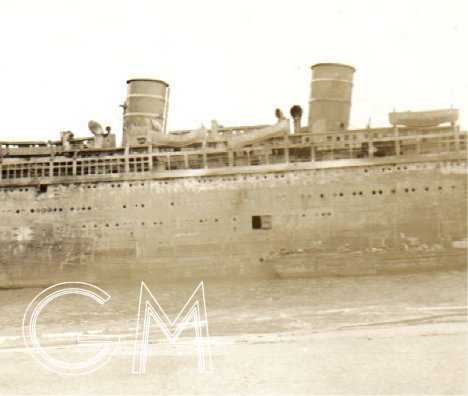
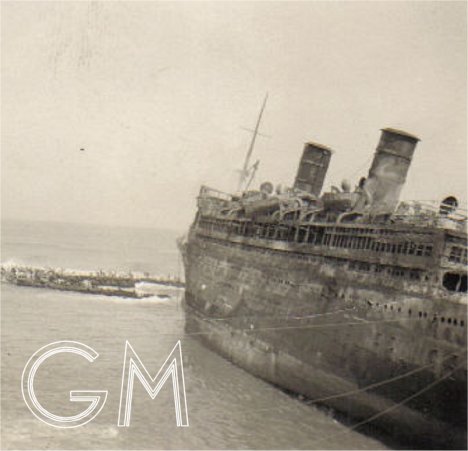
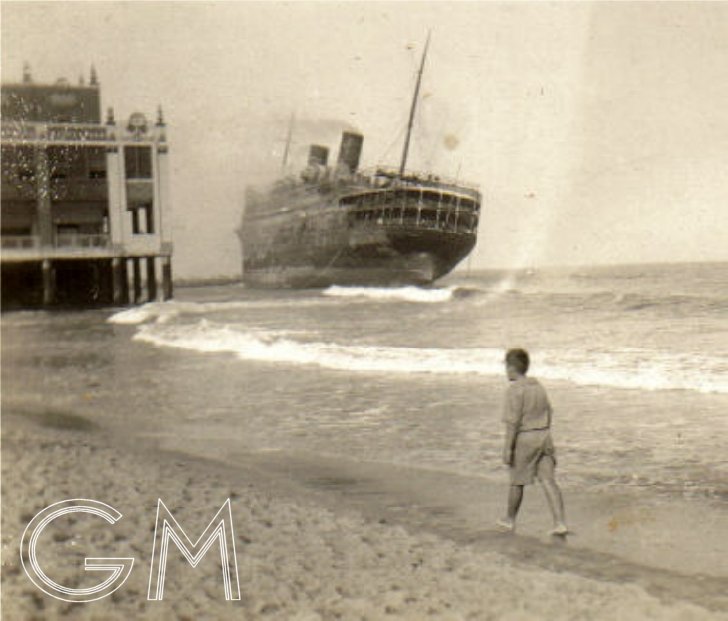
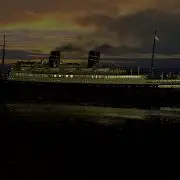
The ship these passengers were aboard was the turbo-electric liner Oriente,
the property of the New York and Cuba Mail Steamship Company, which
is more tersely and less gently referred to as the Ward Line. The
T.E.L. Oriente is fashioned in the image of her clientele:
a sound, young, pleasant and somehow invincibly comic vessel, the
seagoing analogy to a second-string summer resort, a low priced
sedan or the newest and best hotel in a provincial city. She can
accommodate some 400 passengers, and frequently enough carries
half that many. She makes fifty voyages a year, New York-Havana-New
York, carrying freight, mail and passengers, of whom a strong preponderance
are cruising.
CONGENIAL SHIPMATES JOIN YOU IN "PUTTING THE SHIP THROUGH HER
PACES"
.the cruise brochure says, adding "And you'll find the Oriente lives
up to the most exacting demands." It must be suggested that
the truth of such qualitatives as delightful, splendid, delicious
is highly relative. In other words, a lot depends on the point
of view. In that case, the following could quite as reasonably
be said: people don't become so very well acquainted: they are
too shy, and afraid of getting stuck. Few of the passengers have
a royal good time because they have never had a chance to learn
how. The splendid orchestra is hard worked corn fed summer hotel.
The delicious meals are indeed what a cruise passenger might
order in a fine restaurant ashore. Even effervescence is relative;
some people find enough in a bottle of club soda opened night
before last. The passengers spent a good deal of time on their
own resources. Those resources showed their inadequacy in proportion
to the eagerness of the passengers reaction to any program of
fun that was arranged for them. The eagerness in turn was in
proportion to the juvenility of the program. Party hats and noise
makers were sure fire; the moment of loudest and most general
gayety during all six days was the close of a game of musical
chairs: the most steadily popular collective diversion was the
most solidly an irretrievably lower bourgeois: Bingo. There was
a moderate amount of drinking but little drunkenness and almost
no conviviality. Flirtation seldom reached either high temperature
or seriousness. Much of the dancing was constrained; there was
no cutting in. After the first three days the average passenger
was bored with himself and whomever he knew and sank into depression.
And yet that is not the whole truth. The same passenger was possessed
of illusions to match those set up in the brochure, and their
protection was ensured by the genius of his class and country
for self deception. So amphibious was he between illusion and
reality, and so swiftly capable of mending his own wounds that
on the mot essentially literal plane those illusions were quite
as true as the realities.
Up on the sports deck in bright sun a gay plump woman in white
shied rubber rings at a numbered board and chattered with her somber
companion. She admired Noel Coward almost fatuously and sat at
the captain's table. She was the godsend of the week to the captain,
a Dickensian built Swede who enjoyed gallantry and wit, and whom
even the stewards liked. A slender Jew made a few listless passes
art shuffleboard and then settled down to obstacle putting. The
Airedale and a duplicate appeared in naughty trunks, laid towels
aside from their pretty shoulders, oiled themselves, and after
a brief warm up began to play deck tennis furiously before the
gradually assembling girls. Some of the girls wore brand new sports
clothes, others brand new slacks or beach combinations. Some of
them traveled in teams, most of the others teamed up as quickly
as they could. They strolled against the wind, they stood at the
white rail with the wind in their waved hair, they swung their
new shoes from primly crossed knees, they layback with shaded eyes,
their crisp white skirts tucked beneath them in the flippant air,
they somewhat shyly lay their slacks back from their pale thighs,
they lay supine, skull eyed in goggles; their cruel vermilion nails
caught the sunlight. They examined each other quietly but sharply,
and from behind dark white rimmed lenses affected to read drugstore
fiction and watched those beautiful bouncing blond boys' bodies
and indulged in long thoughts of youth. The Airedales were fast
and skillful, and explosive with such Anglo-Saxonisms as Sorry,
Tough, Nice Work, Too Bad, Nice Going. Later they were joined by
a couple of other bipeds who had the same somehow suspect unselfconsciousness
about their torsos, and the exclamations of good sportsmanship
came to resemble an endless string of firecrackers set off under
a dishpan and the innocent childlike abandon of exhibitionism acquired
almost Polynesian Proportions in everything except perhaps sincerity
and results. To come to the quick of the ulcer, it is generously
estimated that the sexual adventures of the entire cruise did not
exceed two dozen in number and most nearly approached their crises
not in staterooms but aboveboard: that in no case was the farthest
north more extreme than a rumpling hand or teeth industriously
forced open; that in 70% of these cases the gentleman felt it obligatory
to fake or even to feel true love, and the lady murmured "Please" or "Please
don't" or "I like you very much but I don't feel That Way about
you" or all three: and that the man, in every case, took it bravely,
sincerely adapted the attitude of Big Brother and went to his bunk
tired but happy.
There were a number of shifts of table at lunch as new acquaintances
got together. It was standard, sterile, turgid summer hotel type
of food, turkey, duck, the sort of stuffing that tastes like kitchen
soap, fancy U.S. salads and so on, and served with a pomp and circumstance
that would have sufficed for the body and blood of Brillat-Savarin.
The average passenger behaved a little as if this were his regular
Thursday evening at the Tour'd Argent and staggered upstairs to
digest at the horse racing. |