21. I have never known such fear
Jim Kalafus and Mike Poirier
Two days after the disaster, portions of a statement issued by Williams
President Tyler Dennett appeared in the press:
(Professor Cleland) was one of our oldest and most revered professors
who by steady persistent effort built up a department of geology of which
Williams College has been very proud.
Lloyd Crowfoot, Julius Palmer and William Symmes, all seniors, had made
honorable places for themselves on the Williams College campus. The reports
of their work, year by year, reveal faithful efforts, sometimes in the
face of considerable hardships. Under Professor Cleland's instruction
they had been touched with his enthusiasm for geology and went to their
fate as young men might, with hope in their faces and the respect and
love of very many friends.
The Telfer family of whom the Pillsbury sisters and Karl Osterhout spoke,
were en route to Mexico where John Telfer, formerly the assistant Chief
Engineer of Mexican National
Railways, would be serving as the British
Vice Consul at Orizaba. Traveling with him were his mother, Mrs Alice
Telfer, his wife,Catehrine Butler Telfer and his two sons Ian
Crichton, 5, and Clive, an infant. The stately elderMrs. Telfer,
67, was brought to the New Yorker Hotel in Manhattan, in shock, while
her grandchildren were taken to the Broad Street Hospital where they
were photographed several times and were the subject of many articles.
John Telfer's body was identified by the New York agent of the Mexican
National Railway on January 26 1935, while that of his wife was tentatively
identified by Alice Telfer who recognized scraps of the clothing the
body wore.
The Peabodys, of whom the Pillsbury sisters and Osterhout wrote,
were Julian and Celestine Hitchcock Peabody, of Westbury, Long Island,
New York. Julian Peabody, 53, was an architect of some reknown who
had designed many North Shore public buildings, including Westbury High
School. He was best known, however, for the extensive renovations to
the Hotel Astor at Times Square in New York City that he designed and
executed. Celestine, 39, was a North Shore socialite known for her
skills as a rider, and was the sister of polo player Thomas "Tommy" Hitchcock.
Their estate, Pond Hollow Farm was said to have been one of the finest
on Long Island. Married since 1913, and the parents of two children,
the socially prominent couple were en route to Guatemala for a winter
vacation: Julian carried his art supplies with him and planned to pass
his time in Central America painting. They were not trapped in
the Sun Parlor and carried down with the ship- both bodies were recovered-
and it is likely that the couple were waiting for the initial rush
towards the lifeboats to die down and simply ran out of time.
Julian Peabody
"The last time I saw or spoke to my parents probably was the week-end before they embarked on the Mohawk.The effect of the sinking and the loss of my parents was catastrophic... Julian L. Peabody jr, Nov 15, 2005
Although some details of their accounts do not dovetail perfectly,
it is likely that music executive James Gibson was in the same boat
as the Pillsbury sisters:
When the boat was lowered it hung stationary at the water's edge. One
of the sailors had an axe and he chopped at the ropes, cutting all but
one when the axe slipped out of his hands into the water.
There we were, with one rope holding fast to the bow of the sinking
ship. It was so cold we could hardly move. We bobbed there for about
15 minutes, then the bow began to go under water and it looked as if
we'd be dragged down. One of the men in the boat had a pen knife. A sailor
took it and was able to hack the rope apart. We drifted away and we were
not clear more than five minutes when the Mohawk sank.
I don't see how the collision could have happened. Someone was to blame;
you could see for miles around.
28 year old, James Howie of Brooklyn gave this account:
I was sitting at the bar with a couple of other fellows when there was
a sudden jar and the boat appeared to come to a stop. I ran out on deck.
I saw the bow of the Talisman pushed far in our side. Then the
freighter backed away slowly.
I walked amidships and asked a member of the crew if there was any serious
damage. He said it didn't look so good, and that he heard two men were
killed in the crash and four others had been washed out of their bunks
through the hole made by the freighter.
Everything was amazingly quiet. The members of the crew were orderly.
They guided us to our boat stations and they lowered the lifeboats without
the least sign of disorder.
There was a year old baby in our boat. There were also about twenty
other people, most of them women.
When we had rowed half a mile from the Mohawk I heard a terrific
blast. Apparently a boiler had burst. I saw the smoke stack falling.
The ship was then at an angle to the sea and it gave me a sick feeling.
I didn't have the heart to see it go down and turned my head away.
Engelbertis "Eddie" DeWaard, leader of the Mohawk orchestra,
survived to give this brief, but good , first person account:
There was no panic. Everyone was just running around, shouting for friends,
trying to get life preservers on, and warm clothes. The crew ordered
everyone to the boats.
First the Mohawk tipped far over to starboard. There was snow
piled up under the lifeboats. Some boats on the port side couldn't be
lowered at all, the Mohawk had listed so bad.
Then the ship straightened up again, ten minutes after the crash, maybe.
They got lifeboats into the water. Then it tilted the other way. It began
to sink by the head. It plunged straight down 80 minutes after it was
hit. There were still may people on it.
We got our lifeboat over all right, but I saw one that hung down from
the davits. The seas were rolling high. We picked up one boy but couldn't
reach any others. I couldn't find my drummer, Anton Woeffel. I think
he died.
Alfonso Garcia 27, Mexican businessman told
this vivid story of the Mohawk tragedy:
I was playing cards in a cabin with three other men I never saw before.
I don't know their names or whether they were saved. After the crash
I dropped my 'near flush' and sprawled on top of the cards. The boys
forgot about the money on the floor as they left the cabin.
Stewards ran about yelling "Put on your lifebelts" I headed
for the passenger dining room where about fifty men and women gathered.
They were calm at first as they were told to await further instructions.
It was a darn long wait for the signal to go upstairs. When we didn't
receive instructions, somebody started a rush for the stairs and most
of them ran up. I was surprised that no one was stepped on, for it was
a pretty panicky group and I don't like to think about some of those
men running.
There was plenty of trouble getting our lifeboat off because of the
ice. Twenty persons, including an eight year old child got in our lifeboat.
There were only two members of the crew in our boat. I helped row until
I no longer could work my hands and arms, which got cold. I then took
an electric torch from a member of the crew
For Mr. and Mrs. Patrick Fitzgerald of Waterbury, Connecticut, the Mohawk
disaster brought a tragic solution to a family mystery. Their son Christopher
had left home in 1926, and the family had neither seen nor heard from
him since. A 32 year old crewman aboard the Mohawk named Christopher
Fitzgerald died in the sinking. He had given a Waterbury address when
he signed aboard the ship, and investigation showed him to have been
the missing man.
"I want a hairdresser and I want her quick" said Evelyn
Levine of New York City and Havana from the Hotel New Yorker where
she had been taken after her rescue. Mrs. Levine had spent her last
$40 to purchase passage to Cuba, where she was to meet her husband,
and had boarded the Mohawk only 5 minutes before the gangplanks
were hauled in.
Well, I'm back in New York again, and I'm broke.
When the ship sailed I didn't immediately go to my cabin, as I wanted
to walk around and get a feel for the ship being a voyager of many
trips. Well, anyway, I was just hanging around the purser's office
when there was the "boom" of the crash. I knew then that the ship was
doomed and nothing could save her.
I'll tell you what it sounded like- that crash was like two houses smashing
together-it knocked me and other passengers down. We then gathered in
the purser's square. I heard someone say "there's water on the decks" then
someone said "Shush! Don't let anyone hear you say that even if it
is true!" Right then I got a little hysterical as I had no life
preserver. So I turned to a member of the crew who had one on him and
said to him "Will you give me your lifebelt" it was crazy to
say such a thing, but now what do you think he did? Why, he jerked it
off and handed it to me without a word, while another sailor helped me
into it.
The crew took orders well, the officers got great discipline from them
and all the passengers kept their heads as far as I could see. I left
in the second lifeboat, as the searchlight from the Algonquin kept
playing on us. Once we seemed to have lost the Algonquin but
we picked her up again. When we got near the Algonquin someone
from the liner yelled "row around to the other side" so we did.
It was pitiful for some of the older women and men. The old men just
stared at the sea while the old women tried not to groan in that awful
cold with water from the sea falling on them.
Gee, I'd love to get to Cuba and see that husband of mine. How'll
I do it?
Mrs. Charles Hone of Eastchester, New York, and her
daughter, Mrs. Stewart Maurice (1894-1992) of Chappaqua, New York met with a
local reporter in Mary Hone's Eton Hall Apartment on Garth Road and
gave a refreshingly candid account of the disaster. In the upper class
manner of the day, they refused to divulge any personal information
or discuss anything other than their having survived the disaster;
even their destination remained 'off limits' for publication. This
was the same Mrs. Ellen Maurice who so charmed the surviving Williams
College boys.
My daughter and I had retired early. We were tired. We had been in our
berths amidships on B Deck. I cant say how long we were in our cabin.
I think I was asleep although I heard the crash and felt the jar from
the impact.
The jar was very slight, not enough to throw us from our berths, and the noise
wasn't very loud. After a few seconds hesitation we got up. Looking out the
porthole we could see the Talisman just a few feet away. We were on the side
that was struck.
We realized the Mohawk had been hit but had no idea it was
serious although something seemed to make both of us realize at once
that we had better don our lifebelts. We threw on a few clothes and put
on the belts. There seemed to be no undue excitement. Only a minute or
two had passed and we were just completing the adjustments on the lifebelts
when our steward knocked on our door. He was calm and in a voice that
showed no alarm or trace of excitement asked if we were awake and told
us to put on our lifebelts and go on deck. We had no trouble reaching
the deck although by the time we got there the Mohawk was listing
badly.
Sailors and officers on the decks directed us to our lifeboat. No one,
passengers or crew, appeared excited. Strangely the vessel's listing
seemed to stop and the ship straightened up just after we had gotten
in the lifeboat. I think the water rushing into the hold probably straightened
up the Mohawk momentarily. It was fortunate because it permitted
the safe lowering of the lifeboat.
There was a bitter cold wind blowing and the sea seemed to be running
very high. At least I thought it was high, although anyone on the
deck of a liner wouldn't call it a 'high sea.' It certainly seemed
rough in that lifeboat. The sailors in our boat got it away from the
side of the ship in a very short time.
In our boat there were about eleven women, eight men and six or seven
members of the crew. The crew did have some trouble keeping the craft
moving. The wind that was blowing and the cold water that splashed in
a spray into the little boat made maneuvering it rather difficult. I
thought we'd freeze out there. We wore very little clothing.
We hadn't gone very far. It seemed as though not much more than twenty
minutes or a half hour had elapsed since the Mohawk was struck
when we saw her begin to sink. The bow went down and within a few minutes
she disappeared. It didn't seem possible. The whole thing happened so
quickly.
I estimate that the lifeboat was in the open sea for ninety minutes
before we were picked up by the Algonquin. As soon as we were
aboard the Algonquin we were all taken care of. My hands and
ears seemed frozen and found I had hurt my leg in some manner. My injuries
are nothing serious. My daughter escaped with no injuries whatsoever
as far as I know.
The only dry clothing available aboard the Algonquin was a
pair of sailor's pajamas. Besides these I was given a heavy warm blanket.
I want to say that the crew of our ship certainly did all that could
be expected of them. They can't be praised too highly. On board the Algonquin we
were also treated fine.
|
|
Grave of Mary Hone |
Grave of Ellen Maurice |
Courtesy of Jim Kalafus |
Mrs. Jeanette Brucker, of Mansfield Ohio, boarded
the Mohawk
with her sister, Miss Alice Williams, and their mutual friend Miss
Dorothy Dann (1895-1980). The three, later described as "leading figures
in Mansfield society" were trading the cold of an Ohio January
for 24 days in Vera Cruz, Mexico. Mansfield, at the time, had a spirited
newspaper, the News-Journal, and from its pages the pre-tragedy
lives of the three Mohawk women are easy to document; other
than Mary Pillsbury Lord, the Williams College party and the Peabodys,
more can be learned about Mrs. Brucker and the Misses Williams and
Dann than any of the other passengers. For instance:
Four generations of a Mansfield family will be patron members
of the Red Cross for the remainder of their lives. They are Mrs.
Jeanette P. Hodges, 157 Park Avenue West; her daughter, Mrs. Charles
Williams 24 Stewart Avenue; her grand daughter, Mrs. David Brucker,
and her great grand daughter Jane Brucker, of 157 Park Avenue West.
Besides these four, there are five other members of Mrs. Hodges
family who are patron members of the Red Cross.
Miss Alice Williams, a grand daughter, is also on the list.
(November 1933) |
On the night of the collision, Mrs. Brucker and the Misses Williams
and Dann set out for the lifeboats together; however, Miss Dann returned
to her cabin to get a blanket and while
returning was physically propelled
by a crewman into a boat on the promenade deck. Mrs. Brucker and Miss
Williams had continued upward to the boat deck. Aboard the Mohawk,
as aboard the Titanic, confusion over where to board the boats
cost lives: some boats were filled on the boat deck and then lowered
past the passengers waiting properly at their boarding stations one
deck below, while in other cases boats were lowered to and loaded from
the Promenade Deck leaving people who mistakenly went to the Boat Deck
stranded. That is what happened to Mrs. Brucker and Miss Williams.
From her lowering lifeboat, Miss Dann heard Mrs. Brucker calling "Dorothy
Dann- where are you?" from the boat deck. She called back to them,
but never knew whether or not they heard. Both women sank with the
ship and were lost. In a letter to her family Miss Dann wrote:
I had no place to sit, so I stood up for two hours wedged in among a
lot of frantic people. The boat was leaking, the water was up to my ankles.
My hat blew off, I lost my pocketbook containing my valuables.
Our boat crashed into the big boat - the Mohawk. The ropes
on our boat became entangled with the end of the Mohawk that
was going down, and we all thought we'd be drawn down by the suction.
The steward cut one rope with a hatchet and then lost it. A man in
the boat gave him a pen knife and the other rope was cut loose. And
then we were free. There were four or five men in the water near us
crying to be saved. We dragged in two of them but the others went down.
One of the men had on only his underwear- I gave him my blanket. Then
the cold was terrible and I have never known such fear.
We watched the Mohawk over on her side, going down rapidly.
I looked once or twice and then turned my head away. It was too terrible.
Mrs. Brucker was found the following day floating close to the wreck
site, while Alice Williams was swept many miles up the coast and not
found for several days. Both women were returned to Mansfield and buried
at Mansfield Cemetery. Unfortunately, the story does not end there:
OHIOAN'S BODY FOUND HANGING IN APARTMENT
Mansfield Man Takes Own Life In Phoenix Arizona.
Grieved For Wife
Man Despaired Since Wife's Death In Mohawk Ship
Disaster.
David F. Brucker, 44, Mansfield, was found dead in his apartment
in Phoenix yesterday. Police said the body was found hanging
from a steam pipe in the kitchen.
Officers said Brucker, a former ice cream manufacturer, had
been despondent since the death of his wife in the Mohawk disaster
last January. An inquest was held to be unnecessary.
"There is no doubt about the identification" Judge Brucker
told the Associated Press when informed of the death. He said
his son, who visited here about a month ago, went to Arizona
for his health. Brucker had worked as an ice cream and coffee
salesman, and is survived by a daughter, Jane, 20, who resides
in Mansfield.
(August 17, 1935) |
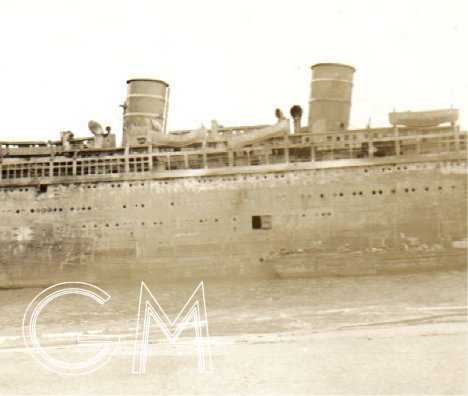
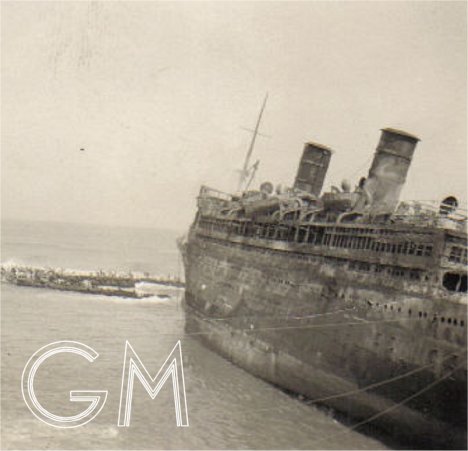
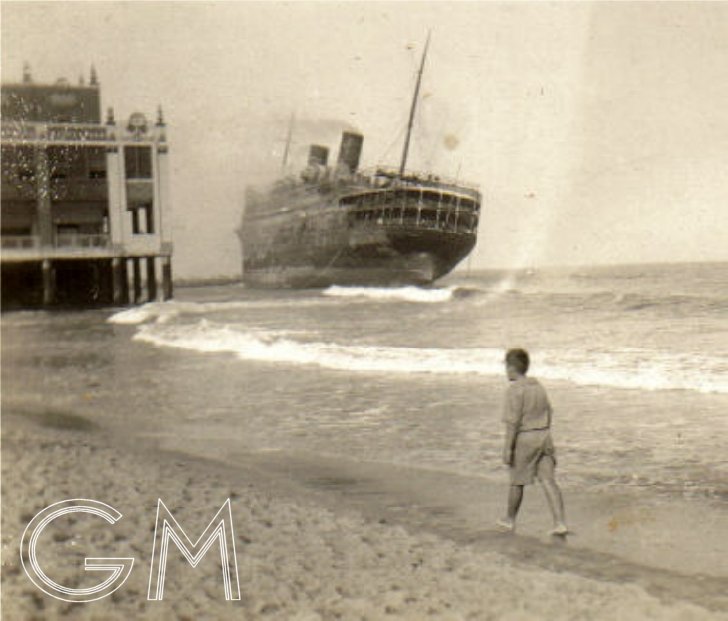
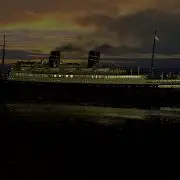
The Mohawk came to rest in 70 feet of water, six
miles off of Manasquan, New Jersey. She lay almost within sight of
the Morro
Castle's hulk, and airplanes conducting aerial searches for Mohawk
victims flew in close to the earlier wreck and photographed it; winter
storms had moved her further down the beach in the direction of the
Convention Hall, giving the resulting photos an unfamiliar look. A
pair of lifeboats that self launched from the sunken boat deck drifted
forlornly above the Mohawk, still tethered to their davits, while the
bow of a third boat attached only by the stern, pointed towards the
sky over the wreck. Most of the 47 victims were found drifting in a
cluster close to the wreck site, but some- such as Alice Williams-
had been taken by the current and drifted up the coast. A handful were
never found.
The Mohawk, despite the social prominence of some of her survivors
and victims, her high death toll, the proximity of the wreck to New
York City, and some disturbing questions regarding safety and stability
raised by the collision, vanished rapidly from both the press and public
consciousness. Unfortunately for her posterity, the disaster occurred
during the final week of the Hauptman trial and, unlike, the Morro
Castle,. there was limited column space available to cover the story;
even on day one, the Mohawk tragedy shared a split headline with
Hauptman on the cover of most newspapers.
One senses, reading through the U.S. Government report
on the disaster, issued in 1937, that the press missed a great story.
The report frustrates the contemporary researcher, for it is a detailed
series of recommendations pertaining to both the Morro Castle and Mohawk
affairs, and makes references to other reports from which it was culled,
without quoting directly from them. Of particular interest, at one point
the report describes "four
compartment' "three compartment" "two compartment" and "one compartment" ships,
as determined by the amount of damage they could sustain and survive
in an accident, and then goes on to say, in a passing reference:
The Mohawk, under the laws in effect when she was built, was
not even a one compartment ship. While it is true that had the Mohawk been
subdivided in accordance with the convention requirements, and had
she been stable when in the damaged condition she would probably not
have foundered.
The members of the Committee on Commerce, for whom the final report
was intended, would have heard the testimony and read the accounts
which support that statement, and therefore no further expansion on
the theme was needed, however, to a historian it raises and does not
answer a number of nagging questions. A search is currently underway
for the full testimony and supplemental reports that went into the
creation of the final paper, and more will be said on this most interesting
of tangents as information becomes available.
The Morro Castle was pulled free from the beach at Asbury
Park, at last, on March 14, 1935. She was towed first to Gravesend
Bay in New York, and then on March 29th to Baltimore, Maryland where
her remains were scrapped at the Union Shipbuilding Company.

Scrapping the Morro Castle
On June
28th, she caught fire once again when bilge oil was ignited
by a scrapper's blowtorch. At about the same time, the Mohawk,
resting in water so shallow that on sunny days she was visible from
the air, was dynamited and wire dragged as a hazard to navigation.
The job proved to be more difficult than anticipated:
SUNKEN WARD LINER RESISTS DYNAMITE
Though she sank easily, the Ward liner Mohawk is stoutly
resisting the efforts of engineers to blow her to bits on the
ocean floor.
The Mohawk went down after a collision with the freighter
Talisman last January with the loss of 46 lives. She lies in
80 feet of water, a menace to navigation in the busy steamer
lanes.
Efforts to break the hull with charges of dynamite were begun
last week by a salvage crew. The first explosion shook but failed
to break the hull.
Another was touched off yesterday, but engineers indicated that
at least three more charges would be needed.
(August 6, 1935) |
Her bow survived the blasts, lying on its side, but the rest of
the liner was reduced to a low-relief jumble of wreckage strewn across
the ocean floor. Since the advent of SCUBA , she has become one of
the most popular dive sites on the East coast due to her closeness
to shore, shallow depth, and seemingly endless supply of artifacts.
Part 22 : The end of the
Line