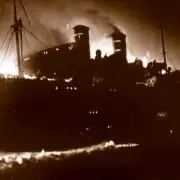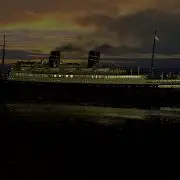
19. Taking Water FastClyde Mallory's Mohawk commenced her Ward Line maiden voyage on Thursday, January 24, 1935 from Pier 13, East River, at the foot of Wall Street. The tail end of the worst winter storm of the year, a blizzard that dumped 17 inches of snow on Manhattan, was dispersing and the weather remained dismal 'though clearing through the day. Passengers who traveled in to Manhattan by private car or cab later spoke of interminable delays, particularly on the bridges, as the city struggled to dig out from under the atypically heavy snowfall. All in all it was not a particularly festive sailing day, but it is likely that the passengers and crew were buoyed by the thought that they would soon be in sunny Havana or Mexico, or points beyond. Among those who probably watched the financial district skyline glide by from inside the ship, grateful to be warm and indoors as she made her late afternoon departure, were a prominent NYC architect and his socialite wife; a member of the British diplomatic corps traveling to his new assignment in Mexico with his wife, mother and two sons; a pair of sisters who were heiresses to one of America's great industrial fortunes, and a party of students from Williams College en route to Mexico with their professor-mentor. There was a party of women from Mansfield Ohio beginning a 24 day vacation; a wife returning to her husband in Havana, and-although not brought to the attention of the passengers- there were the several Morro Castle survivors on the crew list. The Mohawk, part of a quartet of liners bearing the names of American Indian nations, was a single funnel vessel, measuring 402' X 55' and weighing 5896 tons. Her passenger accommodations and public rooms were spread out over three decks, with her lounge and dining saloon far forward on B and C decks respectively; her smoking room, deck verandah, barber shop and sun parlor at the rear of A deck, and a social hall amidships on B Deck. Her accommodations ranged from two room suites with private bath and toilet facilities, to minimum fare inside "upper and lower" cabins. Externally, the Mohawk could be described as sturdy rather than streamlined, and internally she was comfortable and, in places, quite elegant but by no stretch of the imagination could she be referred to as palatial. Photos show her furnishings to have been typical of what would have been found in upper middle class residences of the 1920s, and with her single deck public rooms scaled to her relatively narrow beam the overused adjective "homelike" was- for once- appropriate. Since her maiden trip in February 1926 she had earned a reputation for being a friendly and efficient ship, and those who embarked on her final voyage had no reason for trepidation.
If the Ward Line ships of the late 1920s and early 1930s can be said to have been noticeable for the sheer volume of innuendo that swirled around them, then the Mohawk - class of Clyde Mallory Line vessels were outstanding for the sheer number of collisions - small and large- in which they were involved during their first decade of service (e.g. Cherokee). The two most notorious incidents took place in lower New York Harbor, and each involved one of the Clyde Mallory vessels to figure in the Mohawk disaster. The better remembered also involved one of the future heroes of the Morro Castle rescue fleet. Captain A.R. Francis, under the command of whom the crew of the Monarch of Bermuda played a pivotal role in the rescue of the Morro Castle survivors, and the Clyde-Mallory liner Algonquin, which played a pivotal role in the rescue of the Mohawk's survivors, crossed paths in a well-publicized and embarrassing incident in December 1929:
Much of the United States was battling the Blizzard of the Decade on December 20, 1929, with 25 deaths across the American West, 60 MPH winds bringing Great Lakes traffic to halt and rendering air traffic impossible, as the Furness-Bermuda Line's Fort Victoria and Clyde-Mallory's Algonquin departed their respective piers for Bermuda and Miami/Galveston. Thick fog blanketed New York Harbor, and although the blizzard had not yet arrived, heavy sleet was falling. The Fort Victoria, after sailing at reduced speed to Sandy Hook, was halted near the lightship to drop pilot when the Algonquin, not legally required to depart under pilot, loomed out of the fog and rammed her on her port side just forward of amidships. Fort Victoria's passengers were safely evacuated by tugs, and taken to Staten Island or back to the Furness-Bermuda pier, and an unsuccessful effort was made to lash the listing ship to the Algonquin. An equally unsuccessful effort was made to tow her into shallow waters, but she slowly capsized and sank. Fortunately, there were no lives lost. A year and a half earlier, the Mohawk endured her first bout of unwelcome publicity when she became the most seriously damaged of six liners to collide in Lower New York Harbor while moving through a thick fog. The incident was treated with borderline amusement by the newspapers, for there were no deaths or serious injuries. Holland-America's Veendam and the Bull Line's Porto Rico collided near Gravesend Bay, Brooklyn and although early radio messages from the Veendam seemed dire, with water entering her engine room, her crew managed to stem the flow and the following day she sat anchored in Gravesend Bay, damaged but in no danger of sinking, while the Porto Rico was beached in the shallows nearby. The Pennland was struck by the smaller Anniston City, near Sandy Hook, with both ships seriously damaged and taking on water but surviving. The excursion vessel Smithfield, off course in the fog, ran aground with little damage. And, as for the Mohawk:
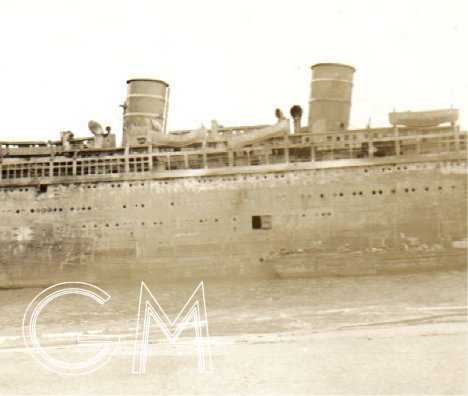
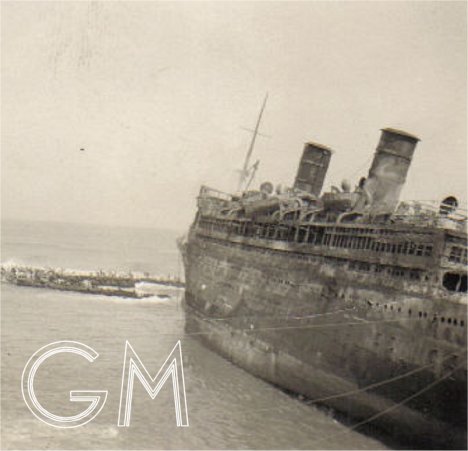
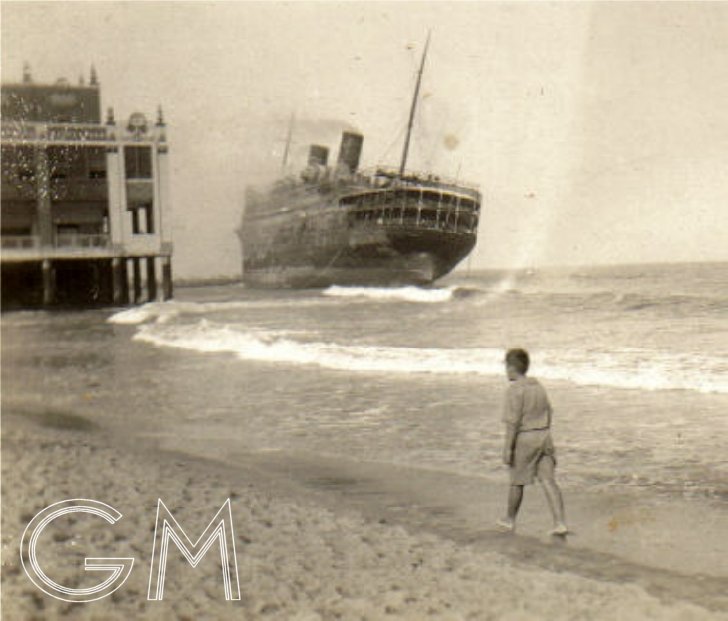
The Mohawk, grounded parallel to the beach, and less than her length offshore, was evacuated the following day. Photos show the passengers smiling as they were disembarked by lifeboat. Because of the proximity to a public beach near New York, the stranded ship became the subject of hundreds-if not thousands- of press and private photographs before she was towed away for repair work. The event was well publicized but certainly not earth shattering and it is doubtful that any passengers aboard the Mohawk in 1935 gave it any thought as the liner passed the site of the collision near Sandy Hook. Small fragments of what went on aboard the Mohawk during her final six or so hours of life can be gleaned from survivor accounts. The liner lost several hours of voyage time when she paused to adjust and test her compass once beyond Sandy Hook. A "pleasant," but delayed dinner was served. The passenger compliment was described as "congenial." The door connecting the lounge to the enclosed promenade deck did not fit snugly and there was a noticeable cold draft along one side of the room. Little was later said with regards to the liner's décor or physical layout: the passengers were not aboard her long enough to retain detailed memories of her public rooms and, in truth, the Mohawk simply was not the sort of liner to cause passengers to wax rhapsodic, although a handful later did describe their accommodations as being "comfortable." Only two incidents from the Mohawk's final night were widely reported: after sunset, and a short time before the accident, word was spread among the passengers in the lounge that Asbury Park was drawing abreast along the starboard side and a group of interested passengers left the heated comfort of the lounge to see if the hulk of the Morro Castle was visible across the five miles of water that separated the two ships. And at the moment of the collision the ship's orchestra was playing "I Saw Stars." Shortly after 8:30 PM the lights of the Norwegian freighter Talisman became visible ahead, and to port, of the Mohawk. There was never any question that the two ships saw one another, and there seemed to be nothing out of the ordinary or dangerous in the situation: they were traveling in the same direction and on parallel courses. However, as the Mohawk drew abreast of the Talisman at 9:25, something went catastrophically wrong, and the liner veered suddenly, and at full speed, across the Talisman's bow. The Mohawk listed severely to port, recovered, and listed severely again before she sank about 70 minutes after the collision. The evacuation was calm but not particularly well organized, the Talisman lowered no lifeboats to render aid, and the Mohawk's passengers and crew lost valuable time freeing frozen lifeboats from their davits. The Algonquin, northbound on a freight voyage with no passengers aboard, and the freighter Limon arrived on the scene in time to sweep the sinking liner with their search lights giving those in the lifeboats, and those trapped aboard the Mohawk, a clear view of the final moments. Mohawk Lifeboat The best official account of the Mohawk's collision and foundering was given at the United States Steamboat Service inquiry by her only surviving officer. Chief Officer Cort Peterson began his time on the stand by explaining how it happened that the faster Mohawk was in a position to overtake the Talisman, which in addition to being slower had also departed from Brooklyn an hour after the Ward Line vessel sailed from East River Pier 13 in Manhatttan. The Mohawk, as it turned out, had been delayed in the lower harbor for over three hours while her compass was adjusted, during which time the Talisman had passed her. Peterson then moved on to the accident. He was in the Number 1 hold at the time of the collision, and ran on deck in time to see the bow of the Talisman pull out of and away from the Mohawk's side.
Peterson then described the lowering of the boats. #4 on the port side got away first, followed by starboard boats #5 and #3. Peterson escaped in #2, which contained only twelve to fourteen crewmen.
With Captain Wood and all but one of the Mohawk's officers dead, the highest ranking person to give testimony was Captain Edmund Wang of the Talisman: The night was clear. The Talisman was headed to pass off Barnegat Light on her starboard, some fifteen miles ahead. The Mohawk was observed a mile or two distant on the Talisman's starboard quarter. She was overtaking the Talisman on the Talisman's starboard side. The Mohawk was going much faster than the Talisman and drew abreast of her and then ahead. As the Mohawk was drawing ahead, she suddenly sheered sharply to port and ran directly across the Talisman's bow at nearly right angles. The Talisman at once reversed her engines and starboarded her helm, but the Mohawk came directly in front of her bows at high speed. The Talisman's stem came into contact with the Mohawk's port bow forty or fifty feet from the Mohawk's stem. The Mohawk's speed swung the Talisman around to the east and the vessels parted. The Talisman sent out wireless calls for help and messages were exchanged between the Mohawk and the Talisman. The steamers Algonquin and Limon came up and picked up those who were in the Mohawk's lifeboats. A Coast Guard cutter also assisted. The Talisman stood by to give help, and remained all night cruising about and looking for survivors. Questions immediately arose regarding the Talisman's actions after the collision. Despite her close proximity to the foundering Mohawk, three ship's lengths at the beginning of the liner's foundering and less than a mile away at the end, she carried not a single survivor back to New York. Captain Wang was questioned at the United States Steamboat Service inquiry and his answers prove a disheartening contrast to his self- assured final paragraph above:
The transcript of the radio record of the Mohawk's final hour was then read into the record and there was no refusal of aid by Captain Wood contained in it. When the first exchange of radio messages between the two ships took place the Talisman was about three ship lengths way from the fatally injured Mohawk.
Captain Wang also claimed that he heard no warning whistle signals from the Mohawk at any point before the collision. Testimony from quartermaster Edwin Johnsen who was at the helm at the time of the collision, and lookout Bjarne Johansen, was then read into the record contradicting the statement of Captain Wang. Both men swore that they had heard several short blasts of the Mohawk's whistle immediately before the collision, and Johansen admitted to abandoning his post so that he "wouldn't get hurt." At which point Wang admitted that he knew that there was going to be a collision but did not specify how long before the crash he knew. "I was staying my course" he said, and then gave the additional detail that one of his officers made the comment "I bet his steering gear is gone!" A portion of Mohawk look-out Frank Novak's account survives:
George Clancy testified:
Mary Pillsbury Lord, (1904-1978) future U.S. Delegate to the United Nations General Assembly (1958 and 1960) and U.S. Representative to the United Nations Human Rights Commission (1953-1961) and her sister Katherine Pillsbury McKee (died 1978) were aboard the Mohawk's fatal voyage. Both survived, and a few days later Mary's husband Oswald Lord wrote a narrative account of the sisters' experiences which was meant to answer as many questions as possible to reduce the number asked of them during the weeks to come as they tried to forget the disaster.
Mary Pillsbury Lord was in the early stages of pregnancy when she survived the disaster. Her son, Richard Lord, was born on July 30th, 1935 and died on October 23rd of the same year. She had two other sons, Charles Pillsbury Lord and Winston Lord. Winston served as U.S. Ambassdor to China 1985-1989, Assisstant Secretary of State for East Asian and Pacific Affairs beginning in 1993, and as the co-chairman of the International Rescue Committee. Part 20 : The Yucatan Expedition |
Algonquin Mohawk Class Deckplans I Saw Stars Mohawk
|
|||